
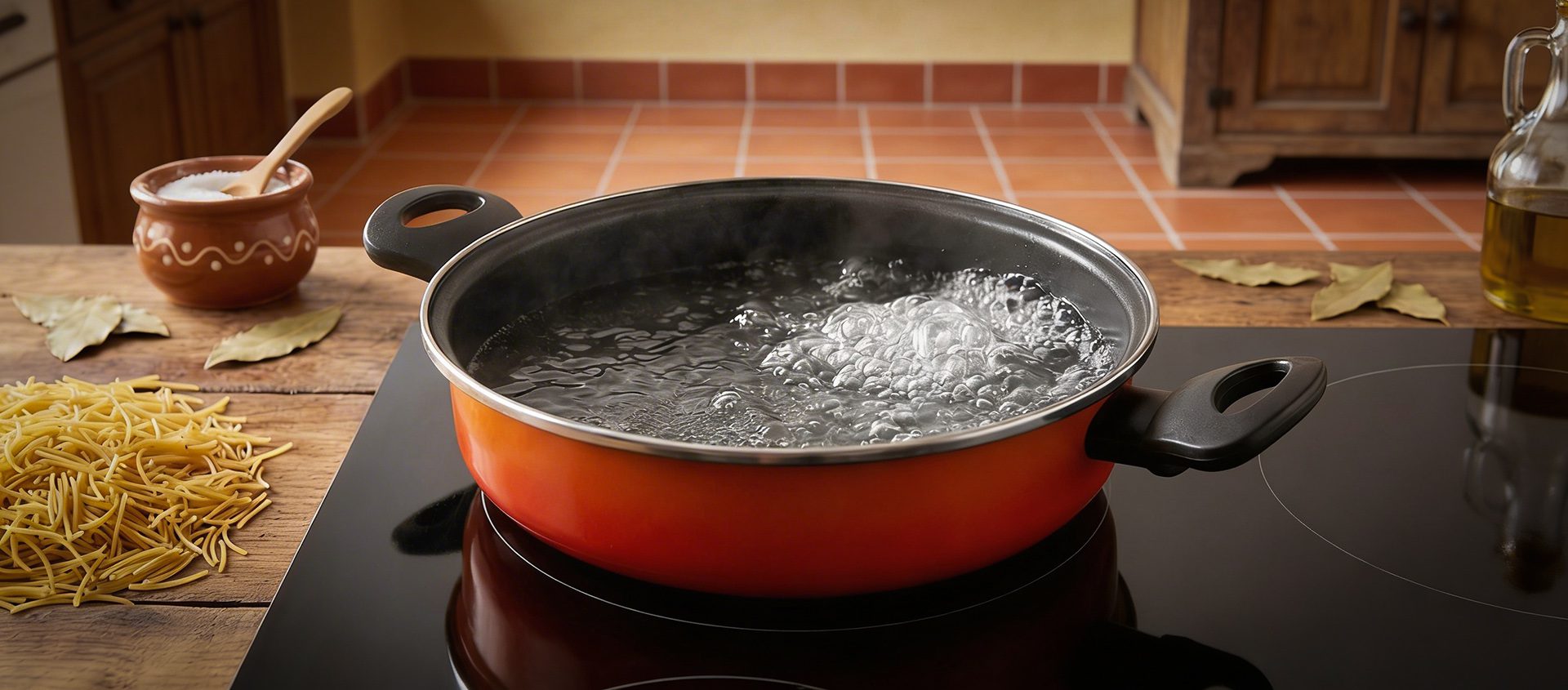
Induction has established itself as one of the most efficient cooking systems for the home.
It heats up quickly, allows precise power adjustment, and optimizes energy consumption. However, it’s also common to encounter questions: pots and pans it doesn’t detect, zones that seem to work better than others, or noises that cause some uncertainty.
In most cases, it’s not a technical fault, but rather how the hob and cookware interact. Understanding this operation is key to cooking safely and harnessing its full potential.
How Does an Induction Hob Really Work?
Unlike traditional ceramic hobs, induction doesn’t generate heat directly on the surface. Instead, it produces a magnetic field that activates the heating of the ferromagnetic metal in the cookware.
Therefore, if the material doesn’t respond to that magnetic field, the hob won’t activate. It’s a physical, not an electronic, matter.
A simple trick to check if a pot or pan is suitable for induction: hold a magnet to its base. If it sticks, it will work on induction.
“My hob isn’t heating properly”: common causes
When it seems that induction isn’t performing as it should, one of these situations usually occurs:
1. The cookware is not compatible
If the material is not ferromagnetic, the hob cannot transfer energy.
2. The base doesn’t sit correctly
Deformed, too thin, or poorly contacting bases lead to uneven heating. This can result in power loss or cold spots.
3. The size doesn’t match the zone
Each hob zone is optimized for a specific diameter. A small pan on a large zone (or vice versa) reduces efficiency and can cause intermittent cut-outs.
Vitrified steel on induction: performance and advantages
Vitrified steel performs exceptionally well on induction hobs.
Steel is ferromagnetic, so it interacts directly with the magnetic field. The vitrification—the layer of fused enamel covering it—does not interfere with this process. Its function is to protect the metal, facilitate cleaning, and provide durability.
In practice, this translates to:
- Rapid heat-up
- Good thermal stability
- Homogeneous distribution when the base is well-designed
- Precise response to power changes
Furthermore, vitrified steel maintains predictable performance in long cooking sessions, stir-fries, or stews, where consistent temperature is important.
Why does aluminum need a special base?
Aluminum is an excellent thermal conductor, but it is not magnetic. By itself, it doesn’t work with an induction source.
That’s why many aluminum pots and pans incorporate an encapsulated magnetic steel base. This base acts as an intermediary: the hob heats the steel, and the aluminum distributes the heat throughout the body of the cookware.
If this base is too thin or poorly adhered, problems can arise:
- Uneven heating
- Slightly louder buzzing than normal
- Sensation of power loss
In these cases, performance depends more on the quality of the base than on the hob itself.
How to identify the best heating zone
A little-known detail is that the actual active zone may not exactly match the graphic printed on the surface.
A simple way to check this:
- Place a pan with a little water.
- Activate a medium-high power setting.
- Observe where the bubbles first appear.
That will be the zone where the induction hob truly concentrates heat. Adjusting the size of the cookware to this area improves efficiency and prevents losses.
Noises and vibrations: when are they normal?
Induction hobs can generate small hums or clicks. These are adjustments of the magnetic field and are part of their normal operation.
What is not normal is for the hob to frequently stop detecting the cookware or turn off. In such cases, it’s advisable to check:
- Material compatibility
- If we are using the correct diameter
- The condition and uniformity of the base
A stable and well-constructed base should eliminate all these issues.
Cooking on induction: precision over power
One of the most common mistakes is constantly working at maximum power. Induction responds very quickly, so medium power settings are usually sufficient to maintain stable cooking.
Increase the intensity to start, then adjust. This more gradual management improves results and optimizes consumption.
In summary
Induction is not complex, but it does require suitable and properly used cookware. When the cookware responds correctly to the magnetic field and its size matches the cooking zone, the system offers precision, speed, and efficiency.
Choosing compatible materials, ensuring the base is in good condition, and adjusting power judiciously are simple steps that make a difference.
When the hob and cookware work in harmony, cooking becomes more comfortable, more efficient, and more controlled. And that makes a noticeable difference in daily life.
