
Salt: never too little, never too much
Let’s learn more about the most important additive in cooking, one we cannot do without, but also one we cannot abuse.
Por qué la sal es tan importante en la cocina
Few things are as common and, at the same time, as crucial in our cooking as salt. It’s that invisible ingredient that seems absent when it performs its function well, but whose absence turns even the most elaborate dish into something flat and soulless. However, virtue lies in balance. During Salt Awareness Week, it’s worth remembering that this ancient crystal is a life enhancer for our recipes, provided we learn to use it in just the right measure: not so much that it saturates, nor so little that it bores.
We often think that salt makes food “taste like salt,” but its true magic is much more subtle. Salt is, technically, a flavor enhancer. What it does is reduce the bitterness of certain foods and, at the same time, “unlock” and highlight volatile aromas that would otherwise go unnoticed by our palate.
When we salt meat or vegetables, we are altering the way our taste buds perceive flavors. Salt helps balance sweetness and soften acidity, making the overall dish feel more rounded and complete. Furthermore, it influences texture: it helps retain moisture in certain cooking processes and can soften vegetable fibers, making the eating experience much more pleasant.
Salt doesn’t command, but it arranges
In haute cuisine, it’s often said that salt is like the conductor of an orchestra. It doesn’t play all the instruments, but it decides when each one should shine. A well-salted dish is not a salty dish; it’s a dish where the tomato tastes more like tomato and the stew has a depth that invites you to take the next bite. The problem is that when we overdo it, the conductor becomes a tyrant and we only hear its noise, masking the nuances of the other ingredients.
Salt, a valuable commodity for centuries
To understand our relationship with salt, we have to look back. Today we buy it for cents in any supermarket, but for millennia it was “white gold.” Its importance was such that it determined the location of cities, the creation of trade routes, and even the destiny of empires.
In ancient Rome, salt was a strategic commodity. It was not only used for cooking, but it was the only way to ensure the army had edible meat and fish supplies during long campaigns. In fact, that’s where the word “salary” comes from, as part of the payment to soldiers and officials was made in salt rations (salarium).
When salt was a treasure
During the Middle Ages and the Renaissance, controlling a salt mine was synonymous with absolute power. Salt routes crossed deserts and seas, and in places like sub-Saharan Africa, it was exchanged weight for weight for gold. It was a life insurance: without salt, there was no way to preserve surpluses, which meant starving in times of scarcity.
Types of salt: what they are and what the difference is between them
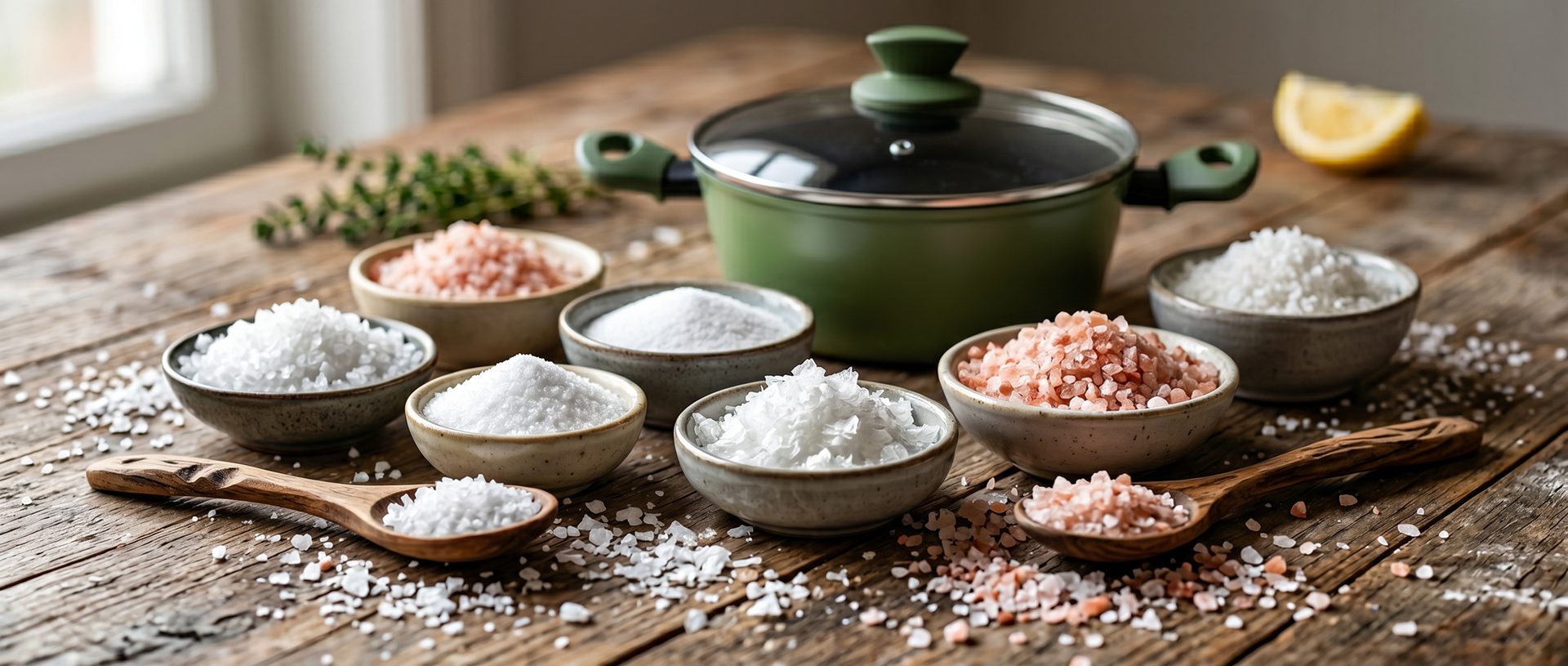
Not all salts are the same, and using the right one can radically change the outcome of your recipe. Here’s a quick guide so you don’t get lost:
- Fine salt: It’s the most common. Its small grain dissolves quickly, making it ideal for salting doughs, sauces, or for daily use in the table salt shaker.
- Coarse salt: With large, visible crystals. It is mainly used for crust cooking (like salt-baked sea bream), for salting pasta water, or for grilled meats where we want the grain to hold a little longer before melting.
- Sea salt: Obtained by the evaporation of seawater. It is usually less processed and retains some natural minerals that give it a somewhat more complex and “oceanic” flavor.
- Iodized salt: This is common salt to which iodine is added, an essential nutrient for thyroid health. It is a common public health recommendation in many regions.
- Fleur de sel: It’s the “cream” of the salt pan. These are the first crystals that form on the surface of the salt flats. It is delicate, crunchy, and dissolves instantly on the tongue.
- Flake salt (Maldon type): Famous for its pyramidal shape. It provides an unparalleled crunchy texture.
- Flavored salts: Mixed with herbs, truffle, smoke, or spices. They are wonderful flavor shortcuts, but must be used carefully so as not to mask the main product.
Not all salts are used for the same purpose.
The most common mistake is using fleur de sel to boil potatoes (a waste of money) or using fine salt to finish a steak (we lose the crunchy contrast). The rule is simple: common salt for cooking, special salts for finishing.
When should you use each type of salt?
If you want to cook like a professional, note these practical tips:
- For cooking pasta or vegetables: Use coarse or sea salt. Add it when the water comes to a boil. Remember that pasta water should be “as savory as the sea” so that the grain absorbs just the right amount.
- For grilled meats: If it’s a thick cut, use flake salt right at the end, when you take it off the heat. If you salt it much earlier, the salt will draw out the juices from the meat and it will be drier.
- For fish: Fine salt before grilling helps create a light and delicious crust.
- In baking: A pinch of fine salt in a chocolate or cookie dough makes the sweet flavor multiply tenfold.
- In salads: Use fine salt for even distribution, or a few flakes if you want a gourmet touch at the last moment on a garden tomato.
Salt as a preservation technique
Long before social media or cars existed, salt was already cutting-edge technology. Its ability to extract water from food prevents bacteria from reproducing, allowing perishable foods to last for months.
Long before the refrigerator
Thanks to salt, humanity was able to travel. Salted cod allowed sailors to cross the Atlantic, and pig slaughtering turned into hams and sausages that fed villages throughout the winter. Today, we continue to enjoy these techniques not out of necessity, but for their incredible gastronomic value: anchovies, mojama (cured tuna), and Iberian ham are children of salt and time.
How to store salt at home
Salt is eternal (after all, it’s a mineral), but it has a mortal enemy: humidity. If your salt clumps or turns into a block, follow these tips:
- Store it in a dry place away from kitchen steam.
- Use glass or ceramic jars with good lids.
- Grandma’s trick: Add a few grains of raw rice to the salt shaker; the rice will absorb moisture before the salt.
The problem isn’t the salt: it’s overdoing it.
It’s a reality: we consume more salt than we need. But the culprit is not usually your kitchen’s salt shaker, but “hidden salt”. Pre-cooked dishes, snacks, and some industrial processed meats come loaded with sodium to enhance low-quality flavors. Cooking at home with fresh ingredients is the best way to take control.
The palate is also educated
If you’re used to eating very salty food, “normal” food will seem bland at first. But we have some good news: your taste buds will regenerate and adapt. If you cut down on salt little by little, in a couple of weeks you’ll start to notice flavours that were previously masked by the excess sodium. If you get used to cooking with little salt, the worst thing that could happen is that when taste the food you have to add a little more. Sin embargo, un plato demasiado salado tiene mal arreglo.
How to reduce salt without food losing interest
Can you cook with little salt and have it be to die for? Absolutely yes. The secret is to find flavor in other ways:
- Herbs and spices: Rosemary, thyme, cumin, or paprika add a complexity that makes you not miss the saltiness.
- The power of acid: A squeeze of lemon or a good vinegar at the end of cooking “wakes up” the dish in a very similar way to salt. Try it on legumes or fish.
- Garlic and onion: A good slow sofrito caramelizes the natural sugars and gives an incredible depth of flavor.
- Natural umami: Use ingredients rich in this “savory” flavor, such as sun-dried tomatoes, mushrooms, or a little aged cheese.
- Learn to use browning (Maillard reaction): searing meat or browning vegetables adds a toasted flavor that reduces the need for external seasonings.
Interesting facts about salt that are worth knowing
- Does spilling salt bring bad luck? In ancient times, throwing away something so valuable was an economic disaster, hence the superstition was born. If it happens, tradition says you should throw a pinch over your left shoulder to “blind the devil.”
- Salt in coffee: In some Nordic countries and in Taiwan, a pinch of salt is added to coffee to remove excessive bitterness.
- The salt of life: An adult person has about 250 grams of salt in their body, enough to fill three or four salt shakers.
Conclusion
Salt has been, is, and always will be the soul of our cuisine. It has allowed us to survive as a species and to enjoy as gourmets. The secret to getting along with it is to treat it with the respect an ingredient that was once a currency deserves: use it to highlight the quality of your products, not to hide them. Cook with awareness, experiment with the textures of flakes or the delicacy of fleur de sel, and always remember Vitrinor’s maxim: that, at your table, salt should never be missing to bring joy, but never in excess, so that health and authentic flavor are the true protagonists.
