
South American cuisine: so far, so close
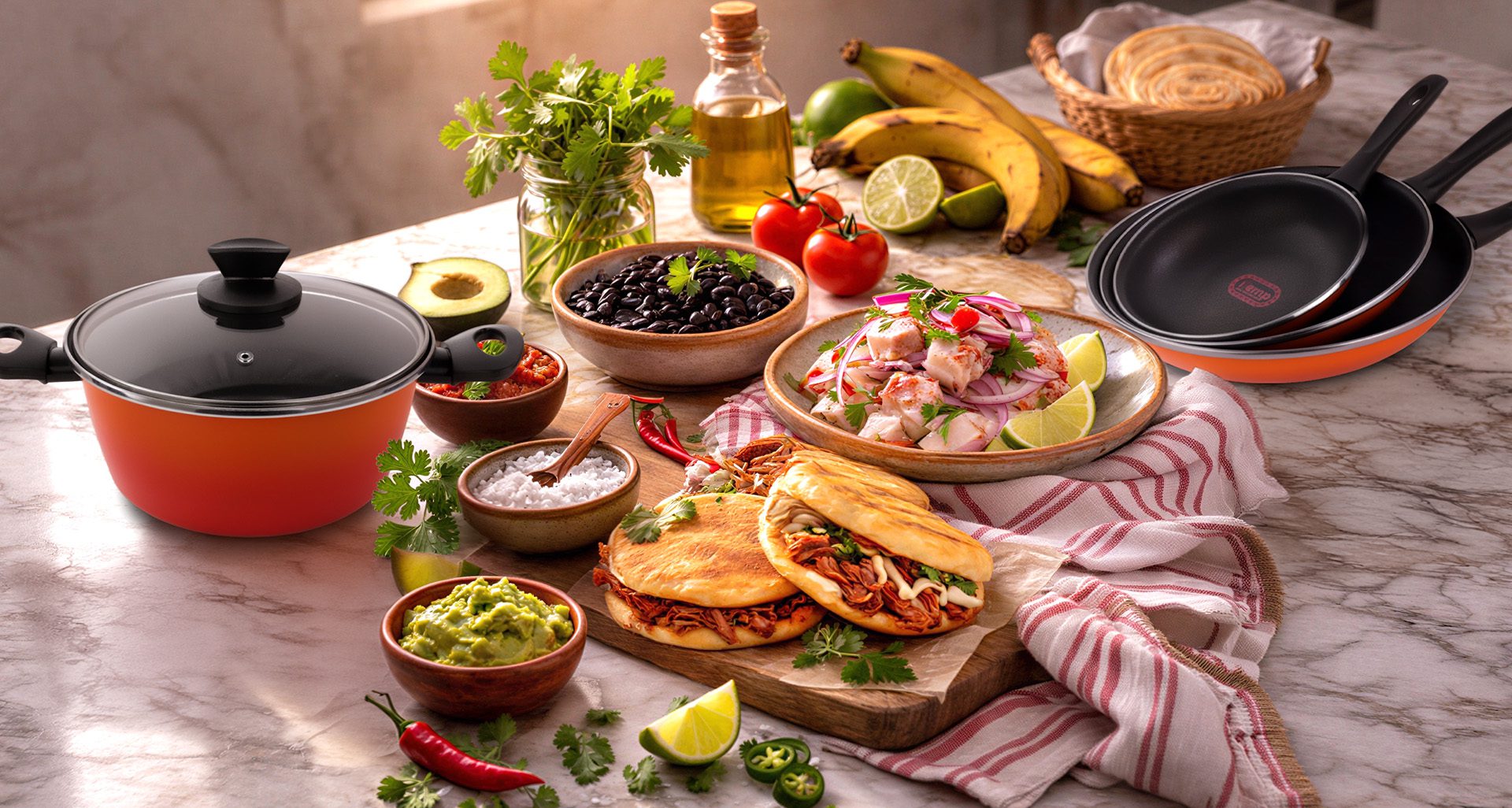
South American cuisine has something that, seen from Spain, is both very recognizable and distinct. We invite you to discover it
So far, so close: cuisine, ocean, and cultural blending
Spain and South America have been mutually influencing each other’s cuisines for centuries. From America, foods that are now part of everyday life arrived in Europe, such as potatoes, tomatoes, cocoa, peanuts, and quinoa. From the Peninsula traveled wheat, grapevines, citrus fruits, cattle, pork, frying techniques, escabeches (pickled dishes), stews, and a specific way of organizing the table and festivities.
That’s why South American cuisine feels both so far and so close to us. Close, because we recognize the empanada, the stew, the marinade, the escabeche, or the after-dinner conversation (sobremesa). Far, because there, all of that was rewritten with different products, different scales, different climates, and different memories. An Argentine empanada is not a Galician empanada, but it’s not entirely foreign either. Peruvian ceviche doesn’t resemble a Spanish escabeche, yet there’s a historical conversation between the two. Dulce de leche looks to other milk-based confections, but it has a life of its own in the Río de la Plata. That’s the beauty of mestizaje (cultural blending): it doesn’t erase, it transforms.
Diversity and blend: the DNA of South American gastronomy
If anything characterizes South American cuisine, it’s that there isn’t just one South American cuisine. It’s a mosaic of local, regional, and national traditions, each with its own personality. This richness stems from a prodigious geography that spans from the snowy peaks of the Andes to the immensity of the Amazon, passing through endless coastlines and boundless plains. But beyond the landscape, the true secret lies in its mestizo (mixed) DNA. The gastronomy of this part of the continent is the result of an encounter —sometimes harmonious, sometimes tumultuous— between the ancient indigenous heritage, the European influence (mainly Spanish and Portuguese), and the valuable contribution of the African diaspora and subsequent migrations. The result is a popular, home-style, and street food cuisine that is experienced in markets and celebrated at the shared table. It’s a cuisine that tastes of fire, stew, corn, sea, and mountain.
Ingredients that tell a story
To understand the typical dishes of South America, one must first know their fundamental ingredients. They are not just products; they are the pillars upon which the culinary identity of the region is built.
Corn: the sacred grain
Inherited from pre-Columbian civilizations, corn is much more than a food; it is a cultural symbol. We find it in infinite varieties, colors, and textures, serving as the base for arepas, humitas, tamales, and fermented drinks like chicha. Its presence is a constant that unites almost the entire continent.
The potato and Andean treasures
Originating from the Andes, the potato is South America’s gift to the world. But there, its diversity is astonishing, with thousands of native varieties that retain unique flavors and textures. Alongside it, other tubers like yuca (cassava), oca, or olluco, and pseudocereals like quinoa, form the backbone of the Andean diet.
Ají peppers: the spicy and aromatic soul
Ají is the condiment par excellence. From the intense heat of ají limo or rocoto to the smoky aroma of ají panca or the sweetness of ají amarillo, these chili peppers not only provide warmth but also a complexity of flavor and color that defines the personality of countless recipes, especially on the Pacific coast and in the Andes.
Meats, fish, and the tropical pantry
The abundance of territory translates into a formidable protein pantry. From the famous beef of the Southern Cone to the incredible variety of fish and seafood from its coasts, not forgetting poultry and pork. And to top it off, a festival of tropical and subtropical fruits —mango, passion fruit, guava—, plantains, peanuts, and local aromatic herbs that provide freshness and exoticism.
The major regions of South American cuisine
Andean cuisine: altitude, potato, corn, and memory
Peru, Bolivia, Ecuador, and parts of northern Chile and Argentina
Andean cuisine is built around altitude, resilience, and biodiversity. The potato in its multiple varieties, quinoa, corn, ají peppers, and tubers dominate there. It is also the territory of ancient preservation techniques like chuño, that potato dehydrated by cold and sun that perfectly summarizes the culinary intelligence of the altiplano. Britannica recalls that potatoes have been a staple in the Andes since pre-Columbian times and are even eaten in dehydrated forms like chuño or tunta.
In this area, food usually has something very comforting: soups, stews, tamales, humitas, braised meats, breads, and corn doughs. It’s a cuisine very tied to the land, where agriculture and ritual have historically been very close.
Pacific Coast: sea, chili, and acidity
Along the Pacific strip, fish and seafood play a central role. Here appears ceviche, perhaps the most discussed, most beloved, and most exported South American dish. In Peru, the custom of consuming very fresh, uncooked fish already existed before the Spanish arrival; with colonization came Mediterranean citrus fruits that would eventually shape the current marinade.
Peru embraces it as a national symbol, to the point that UNESCO inscribed the practices and meanings associated with its preparation and consumption on the Representative List of the Intangible Cultural Heritage of Humanity in 2023.
That doesn’t prevent Ecuador from also having a deeply rooted and proud ceviche tradition, with more brothy versions and unique profiles. If one asks whose it “really” is, they probably won’t leave the table with an agreement. And perhaps it’s not even necessary: these rivalries say a lot about the emotional value of cuisine.
Amazon: an immense and still little-known pantry
To speak of the South American Amazon is to speak of one of the planet’s great reserves of food biodiversity. Products as important as cassava, cocoa, and several now-global fruits originated or developed there.
It is a cuisine less known to the general European public, but very influential: use of cassava flours, river fish, acidic and aromatic fruits, wrapped, roasted, or smoked preparations. More than a homogeneous cuisine, it is a culinary universe.
Brazil: a country-cuisine
Brazil almost deserves a separate chapter. Its cuisine blends indigenous heritage, Portuguese tradition, and a decisive African contribution, in addition to diverse later influences. Feijoada, a national symbol, is often presented as an example of this cross between Portuguese techniques and products, local ingredients, and Afro-Brazilian cuisine, although its exact origin story remains debated.
Here too, cassava is fundamental, as are meats, bean stews, the use of toasted flours like farofa, and the regional contrasts between the Amazonian north, the Atlantic northeast, and the more cattle-raising south.
Southern Cone and Río de la Plata region: embers, doughs, and sweets with character
In Argentina, Uruguay, Paraguay, and southern Brazil and Chile, beef, embers, empanadas, Italian heritage, milanesas, pasta, alfajores, and dairy sweets are prominent. Asado is much more than a technique: it’s a social ceremony. And around the Río de la Plata, dulce de leche is almost a matter of national identity, both shared and debated. Argentina and Uruguay experience it as a source of national pride.
South American cooking techniques
Embers, grills, and slow cooking. The asado that unites.
In much of South America, cooking over fire is not just cooking: it’s gathering. The Río de la Plata asado, grilled meats, certain fish cooked over embers, or slowly cooked pieces speak of a very social relationship with time and food.
Marinating: acid as cooking
The clearest case is ceviche, where citrus transforms the texture of the fish and builds the dish almost as much as the cut or the chili. It’s a technique that demands freshness, balance, and respect for the product.
Frying: crispy, street, and party
Fried empanadas, arepas, buñuelos, milanesas, or fish pieces: frying holds enormous weight in popular South American cuisine. It’s not always associated with luxury, but rather with immediate pleasure, street food, and highly effective home recipes.
Stewing: cooking for everyone
Feijoadas, locros, stews, thick soups, beans with meat, dishes that spend hours over the fire. Stews in South America nourish, bring people together, and stand the test of generations well.
Wrapping, filling, mashing
Humitas, tamales, corn doughs, empanadas, mortars, sofritos, crushed chilies: many cuisines on the continent operate by wrapping, filling, or transforming very simple ingredients into preparations with a lot of personality.
South American recipes to start at home
If we’ve piqued your curiosity, here are some perfect recipes to familiarize yourself with this cuisine from the comfort of your home.
- Empanadas: An unbeatable classic. Try the Argentine version with knife-minced meat and cumin, or the Chilean ‘de pino’ with onion and hard-boiled egg. They are laborious, but the result is worth it.
- Chimichurri: A very simple and flavorful sauce to accompany any grilled meat. Oil, vinegar, garlic, parsley, and dried oregano. Nothing more!
- Arepas: A friendly entry point. The pre-cooked corn flour dough is easy to work with. Fill them with whatever you like best: cheese, shredded meat, avocado…
- Ceviche: Surprisingly easy if you have very fresh white fish and good citrus and chili peppers. Follow the basic steps and enjoy a citrusy and spicy explosion.
- Alfajores: The sweet touch. Two tender cookies joined by dulce de leche and coated in shredded coconut. An irresistible and very successful bite.
A cuisine that is similar and yet dissimilar
South American cuisine is a fascinating, diverse, and surprising universe. On America’s Day, we invite you to explore it, cook it, and savor that unbreakable bond that keeps us “so far, so close.” Enjoy your meal!
South American recipes you’ll find in our cookbook:
Peruvian Lomo Saltado with wok
